
We are pleased to congratulate George Tsitati as he completes his PhD with the University of Edinburgh and takes up a new role with the Danish Refugee Council as Country Anticipatory Action Coordinator in Nigeria. Here we republish his recent LinkedIn post where he reflects on his ‘Pastoralism, Weather and Climate Information Services and Anticipatory Action.’
The picture below was taken during my fieldwork. I took it then without knowing how often I would return to it in my mind. Now that I have finished my PhD awaiting the viva, I look at it differently. It takes me back to the questions I started with, but also reminds me of how much those questions changed through the research.
I began with an interest in how pastoralist communities anticipate and respond to climate shocks and how weather and climate information services can better support anticipatory action. I finished with a much broader reflection on uncertainty, knowledge and the ways we design systems to support decisions in pastoralist settings.
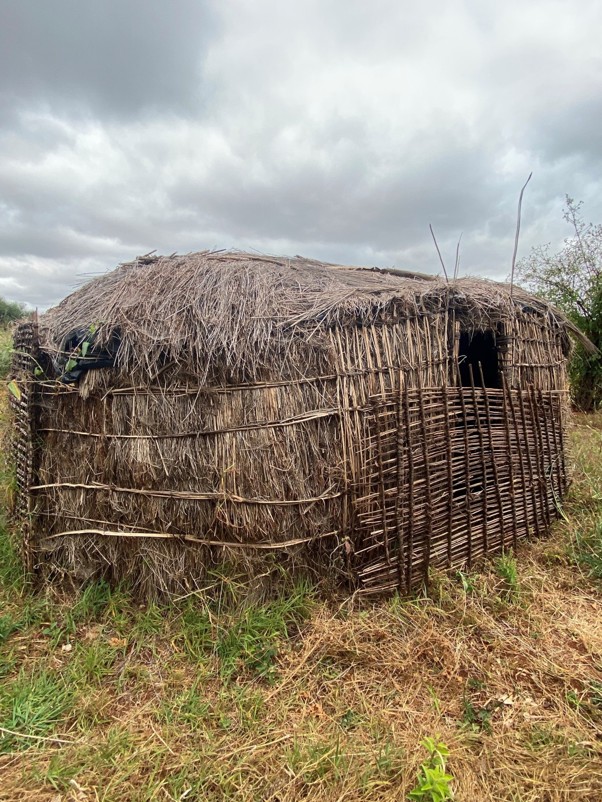
Anticipation and uncertainty
When I started, the logic of anticipatory action seemed relatively clear. Weather and climate information could provide an indication of what might happen, that information could inform decisions, and those decisions could enable action before a shock became a crisis. There is an important strength in this approach. Early warnings, forecasts, triggers and predefined mechanisms can create opportunities to act earlier, particularly where resources need to be mobilised quickly. But working in pastoralist settings made me increasingly aware of the limitations of treating anticipation as a linear process.
Pastoralist livelihoods are shaped by variability, which remains a pervasive analytical vein of the scholarship in pastoralism. As a result, decisions about livestock, water, pasture and mobility are made in environments where conditions can change rapidly and where uncertainty is already part of everyday life. Pastoralists are constantly observing and interpreting their surroundings. They draw on changes in weather, pasture conditions, livestock behaviour, water availability, memories of previous seasons, information from other people and their knowledge of the landscape. These forms of anticipation do not necessarily begin with a formal warning or end with a predefined response. They are continuous processes of reading, deciding, adapting and sometimes changing direction.
This made me question what happens when these forms of anticipation encounter systems built around fixed thresholds and predetermined actions. A drought, for example, may be represented through a particular indicator or threshold, but the implications of changing conditions are not necessarily the same across pastoralist communities or even across households within the same area. The decision to move livestock, change grazing patterns, seek water elsewhere, sell animals or wait for conditions to develop depends on much more than one climate signal. It depends on what people know, what they are observing, what options are available to them and how they assess the risks of different choices.
Pluralist knowledge
This is where knowledge pluralism became central to my thinking. In pastoralist settings, different forms of knowledge can offer different interpretations of the same uncertain situation. Scientific forecasts may indicate a higher probability of drought or rainfall, while pastoralists may be observing conditions on the ground that lead them to interpret the situation differently. These forms of knowledge can complement one another, but they can also compete or contradict each other. I have come to see that competition as something that can be productive. It reminds us that uncertainty is real and that no single knowledge system can provide a complete account of what the future will look like.
For me, mobilising knowledge pluralism therefore means creating space for these different forms of knowledge to be used together, including when they do not agree. The aim is not necessarily to resolve disagreement and arrive at one certain answer. In pastoralist contexts, the disagreement itself can be useful because it can encourage decision-makers to consider different possibilities and avoid placing too much confidence in one forecast, indicator or interpretation. It creates room for questions such as: What else might be happening? What are we not seeing? What would make us change our decision?
This has changed how I think about weather and climate information services. In pastoralist settings, the value of information cannot be separated from the decisions people are making and the options available to them. A forecast may be scientifically robust, but its usefulness depends on how it is interpreted alongside other knowledge and whether it connects with decisions about livestock, mobility, pasture, water and livelihoods. Climate information becomes meaningful through these relationships between information, knowledge and action.
It has also changed how I understand co-production. Co-production is sometimes understood as bringing scientific and local knowledge together to improve a service. My PhD has led me towards a broader understanding. In pastoralist settings, co-production can create space for different ways of understanding uncertainty to shape the design of the information service itself. This includes thinking about what information is useful, when it is needed, how it should be interpreted and what kinds of decisions it can realistically support. It also means accepting that co-production does not have to produce consensus. Sometimes its value lies in making different perspectives visible and allowing them to inform decisions together.
Navigating options and opportunities
These reflections have made me more cautious about rigid anticipatory mechanisms. Triggers and predefined actions can be valuable, particularly when institutions need to act quickly and coordinate resources. But when mechanisms become too fixed, they can struggle to accommodate the realities of pastoralist livelihoods, where conditions and decisions are continually changing. A threshold may tell us that a certain condition has been reached, but it cannot necessarily tell us what the best response is in every pastoralist context.
This is why I have become increasingly interested in reversible and flexible solutions. In an uncertain environment, the quality of a decision should perhaps be judged partly by whether it leaves room to learn and adapt. A reversible action allows people to act before certainty is available while retaining the ability to change direction when new information emerges. This is particularly relevant in pastoralist settings, where decisions are often incremental and adaptive rather than final. The ability to move, adjust livestock strategies, reconsider resource use or change course can itself be an important form of resilience.
This represents a shift in how I think about anticipatory action. Rather than designing systems around the assumption that we can correctly predict a future event and determine the appropriate response in advance, we can design systems that help people navigate several possible futures. That means retaining the value of forecasts and early warnings while allowing space for local interpretation, competing knowledge, uncertainty and revision.
Looking back, I realise that I started my PhD by asking how pastoralists use weather and climate information. I ended by asking a much broader question: what kind of anticipatory action makes sense in pastoralist settings when the future cannot be known with certainty? For me, the answer is beginning to take shape around three ideas: mobilising plural knowledges, accepting uncertainty and designing decisions that can be revisited. These ideas move us away from the search for singular and controllable solutions and towards approaches that can respond to the realities of pastoralist lives.
The future will remain uncertain. Forecasts will sometimes disagree with what is experienced on the ground. Different knowledge systems will sometimes point in different directions. Conditions will change after decisions have been made. In pastoralist settings, this is not an unusual failure of the system; it is part of the environment in which decisions are made.
Perhaps, then, the goal of weather and climate information services should not be to make uncertainty disappear. It should help people navigate it and create the conditions for people to act, learn, and adapt when the future does not unfold as expected. That, for me, is one of the most important lessons from my PhD.
Read the full LinkedIn post: When We Cannot Know: Reflections from My PhD on Pastoralism, Weather and Climate Information Services and Anticipatory Action
Watch an interview with George: