
In April 2026, the Observatory convened an ‘evidence capitalization workshop’ with partners to synthesize insights and key messages on issues and opportunities that can advance early action for dryland resilience and prosperity in the Horn of Africa. This policy brief and accompanying short video are products of this exercise.
Summary
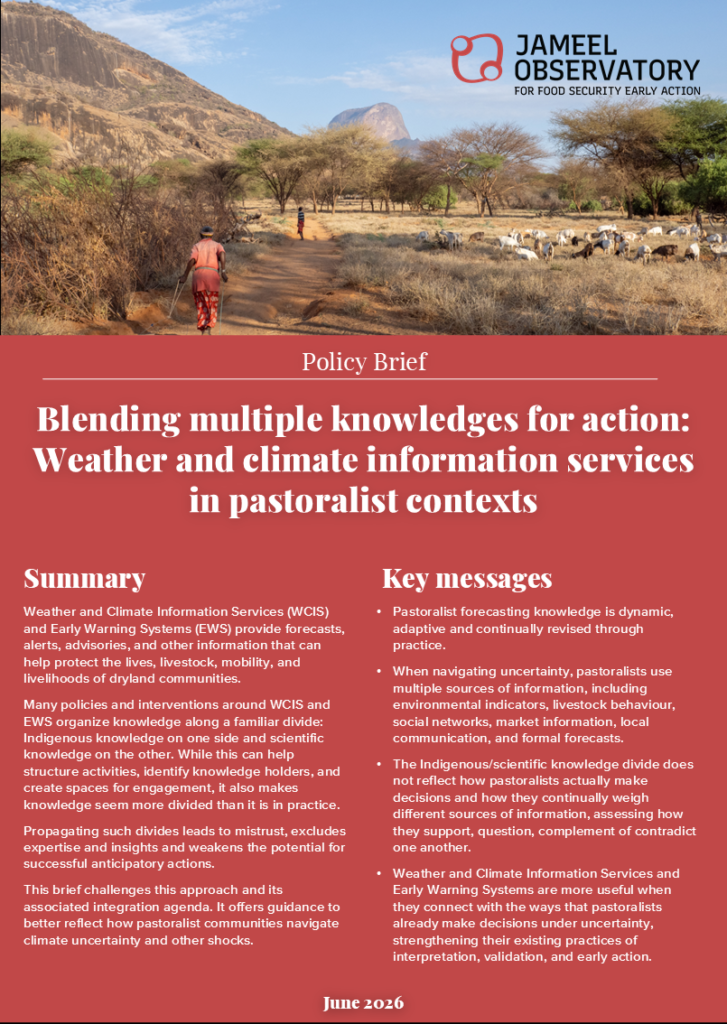
Weather and Climate Information Services (WCIS) and Early Warning Systems (EWS) provide forecasts, alerts, advisories, and other information that can help protect the lives, livestock, mobility, and livelihoods of dryland communities.
Many policies and interventions around WCIS and EWS organize knowledge along a familiar divide: Indigenous knowledge on one side and scientific knowledge on the other. While this can help structure activities, identify knowledge holders, and create spaces for engagement, it also makes knowledge seem more divided than it is in practice.
Propagating such divides leads to mistrust, excludes expertise and insights and weakens the potential for successful anticipatory actions.
This brief challenges this approach and its associated integration agenda. It offers guidance to better reflect how pastoralist communities navigate climate uncertainty and other shocks.
Key messages
- Pastoralist forecasting knowledge is dynamic, adaptive and continually revised through practice.
- When navigating uncertainty, pastoralists use multiple sources of information, including environmental indicators, livestock behaviour, social networks, market information, local communication, and formal forecasts.
- The Indigenous/scientific knowledge divide does not reflect how pastoralists actually make decisions and how they continually weigh different sources of information, assessing how they support, question, complement or contradict one another.
- Weather and Climate Information Services and Early Warning Systems are more useful when they connect with the ways that pastoralists already make decisions under uncertainty, strengthening their existing practices of interpretation, validation, and early action.
More
Watch an interview with George Tsitati: Pastoralists blend multiple knowledges for anticipatory action in Northern Kenya
Watch a longer video exploring these issues: Effective drought early warning in dryland communities – how multiple knowledge systems intersect