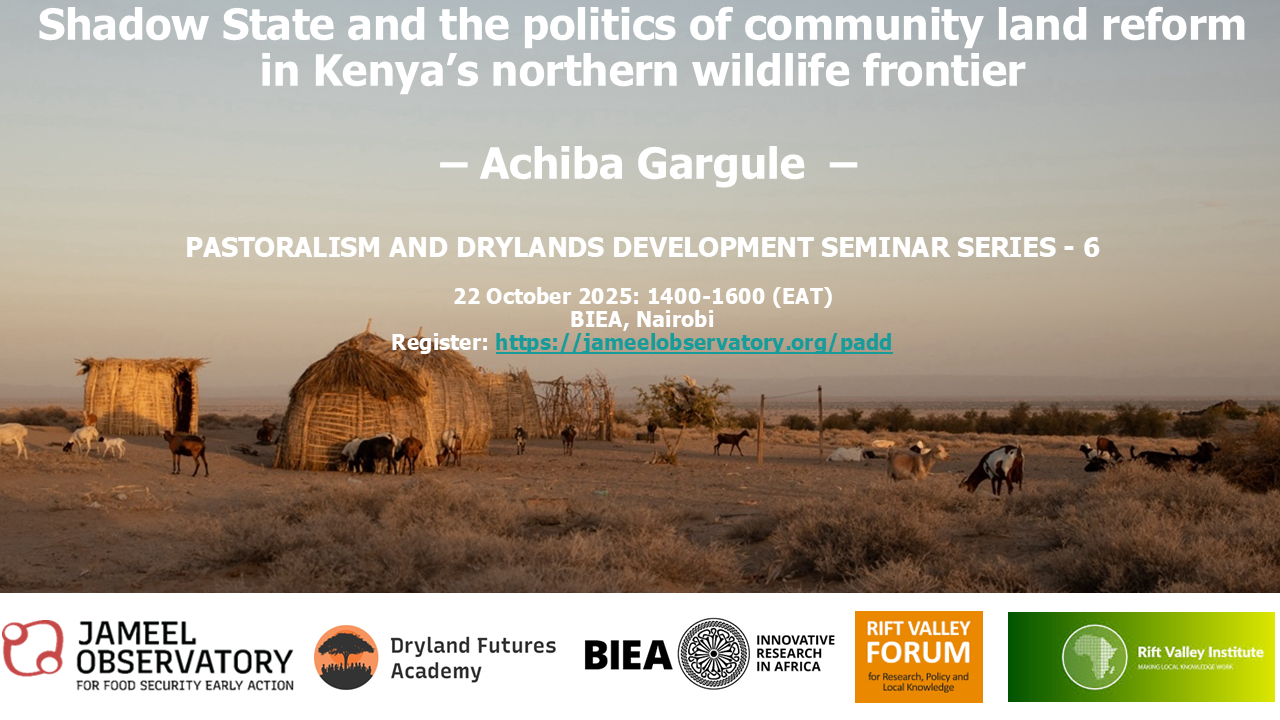
On 22 October, we welcomed Dr. Achiba Gargule speaking at our sixth seminar on ‘Shadow State and the politics of community land reform in Kenya’s northern wildlife frontier.’
Kenya’s 2010 constitution marked a transformative moment in land governance, seeking to dismantle decades of centralized control and address historical land injustices. By recognizing community land as a distinct tenure category, the reforms aimed to secure collective rights, especially for marginalized and pastoralist groups, while promoting locally accountable governance through decentralization of community land administration. Fifteen years on, evidence from Kenya’s northern rangelands reveals a persistent gap between rights on paper and rights in practice, as conservation actors and local intermediaries exert influence through shadow state dynamics—informal networks of authority that parallel and reshape formal institutions.
This seminar interrogated how such shadow governance reconfigures authority and access in Kenya’s northern rangelands, reshaping who benefits and who is excluded from land reform processes. It asked what these dynamics reveal about the limits of institutional “fixes” in addressing deeply embedded political and economic asymmetries. By situating Kenya’s northern wildlife frontier as a site of both reform and resistance, the discussion explored implications for policy, accountability, and the pursuit of justice in community land and conservation governance.
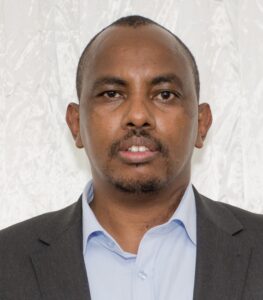
Achiba A. Gargule, Ph.D., is a Human Geographer based at the Feinstein International Center, Tufts University. His research focuses on the political ecology of land and resource governance in East Africa, with a particular emphasis on how land tenure reforms, conservation interventions, and institutional restructuring shape pastoral livelihoods and the management of communal rangelands.
His work interrogates the social and political consequences of contemporary reform processes—examining how they reconfigure authority, access, and equity across Kenya’s arid and semi-arid landscapes. Before joining Tufts, he conducted extensive research on corruption in natural resources, community-based conservation, climate change adaptation, and land reform dynamics across northern Kenya and the Horn of Africa.
More information on the seminar series